
Chromatography is defined as a process separation of essentially molecular mixture. In paper chromatography of ink distribution takes place between an essentially stable adsorbed “liquid” phase and a mobile fluid in contact with it.

Apparatus and chemicals.
1 dm3 measuring cylinder with rubber bung, beaker, Whatman filter paper no. 1, inks of various colors, water and ethanol mixture (6:4).
Procedure.
Take 1 dm3 measuring cylinder fitted with a rubber bung carrying a glass hook at the lower end. Pour 25 cm3 of water and ethanol solvent mixture (6:4) in it
and close it. Allow it to stand for fifteen minutes for the saturation of internal atmosphere with the solvent vapors.
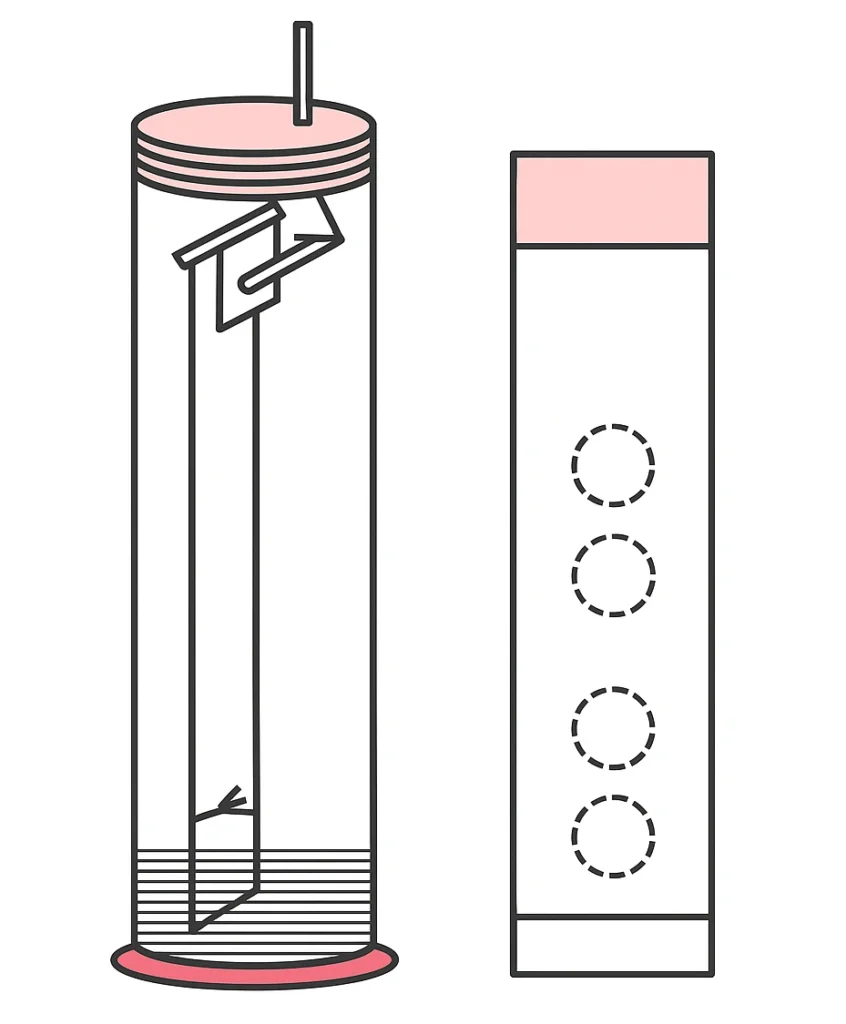
Take a strip of paper (Whatman no. 1 filter paper) 2.5 cm wide and more lengthy than the length of the cylinder. Mark a line 5 cm from one end and its mid-point with pencil. Prepare a mixture of various inks like blue, black, green, red, etc. by taking two drops of each in a clean china dish. Mix them thoroughly. Apply a very tiny drop of this mixture at the mid- point by means of capillary tube or micro-pipette. Dry the strip in the air for about 15 minutes and suspend it by the glass- hook with the impregnated end dipping into the solvent to a depth of 5-6 mm.
When the solvent front has risen for about an hour or the solvent front is 2-3 cm below the upper end of filter paper, remove the paper strip and dry it in air. It is seen that every ink gives colored bands at different regular intervals. Measure the distance of these color bands from the base line and the distance travelled by the solvent front from the base line. Calculate the Rf values for various inks by the formula given above. Thus we can separate a mixture of various paper chromatography of ink.
Precautions.
- The drop should be small and must be dried before the start of experiment.
- Dry spot should not dip in the solvent.
- The strip should be vertical and must not touch the wall of cylinder.
- The surface of paper should not become flooded.